Safety Eyewear
EN166 – Eye Protection Standard
EN166 is the core European safety standard for personal eye protection, covering safety glasses, goggles and face shields used in industrial, construction, laboratory and manufacturing environments.
It defines the minimum requirements for optical clarity, impact resistance, durability and coverage for protective eyewear used in the workplace.
Is EN166 being replaced?
Yes. EN166 is gradually being replaced by EN ISO 16321.
Transition status:
EN166 is still widely recognised and used.
It will be withdrawn once EN ISO 16321 fully replaces it across PPE certification.
Many manufacturers are already dual-certifying to both standards.
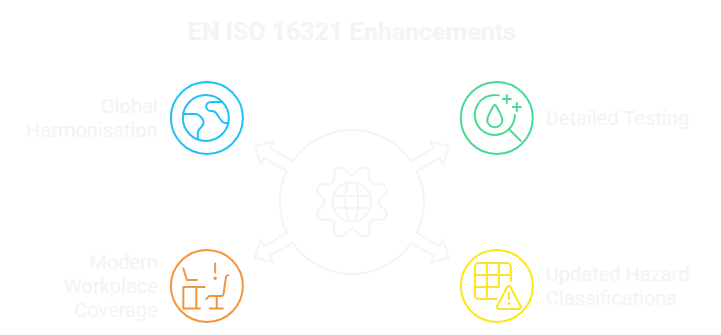
Key difference vs EN ISO 16321
EN ISO 16321 is an international (ISO-based) standard with:
More detailed testing
Updated hazard classifications
Improved coverage for modern workplace risks
Global harmonisation (not just EU)
EN170 – UV Filter Protection Standard
EN170 is a European standard that specifies requirements for ultraviolet (UV) filters used in safety eyewear.
It ensures that safety glasses or goggles protect the eyes from harmful UV radiation while maintaining safe visibility.
Is EN170 being replaced?
Yes. EN170 will be replaced by EN ISO 16321 as part of the new unified eye and face protection standard.
EN ISO 16321 – New International Eye & Face Protection Standard
EN ISO 16321 is the new global standard for occupational eye and face protection. It replaces several older European standards including:
EN166 (general eye protection)
EN170 (UV filters)
EN172 (sun glare filters)
EN169 (welding filters)
Key features
EN ISO 16321 introduces:
More realistic impact testing methods
Wider head-form testing for better fit
New optical classifications
Improved coverage for extreme environments
Simplified marking structure

What this means for buyers
EN166 products remain legal during transition
EN ISO 16321 will become the primary certification
New PPE purchases should increasingly meet EN ISO 16321
Safety Helmets
EN12492 – Mountaineering and Working at Height Helmets
EN12492 is the European safety standard for mountaineering helmets, often used in:
Rope access work
Climbing
Arboriculture
Rescue operations
Working at height
Replacement status
EN12492 remains active and is not currently being replaced, but many helmets now meet multiple standards:
EN12492 (climbing)
EN397 or EN50365 (industrial/electrical)
EN397 Type 2 is to replace the working from height requirement for industrial use
EN397:2012 – Industrial Safety Helmet Standard
EN397:2012 is the long-standing European standard for industrial safety helmets (hard hats) used in construction and heavy industry.
What EN397:2012 covers
It specifies requirements for:
Shock absorption (falling objects)
Penetration resistance
Flame resistance
Chin strap release (must release under certain force)
Adjustable head harness
Field of vision
Limitations of EN397
EN397 focuses mainly on top impact protection.
It does not fully address:
Side impacts
Rotational impacts
Modern construction risks
High-performance chin straps
Replacement status
EN397:2012 is being replaced by EN397:2025.
It will be gradually withdrawn as the new standard becomes mandatory across PPE certification.
EN397:2025 – New Industrial Helmet Standard
The updated EN397:2025 introduces major improvements in industrial head protection and divides helmets into Type 1 and Type 2.
EN397:2025 Type 1 Helmets
Type 1 helmets provide:
Top impact protection (similar to traditional hard hats)
Updated testing methods
Improved retention systems
Modern performance requirements
These replace standard EN397 hard hats used in:
Construction
Manufacturing
Warehousing
EN397:2025 Type 2 Helmets
Type 2 helmets provide:
Top and lateral (side/front/rear) impact protection
Enhanced shock absorption
Better retention and stability
Protection similar to climbing-style helmets
These are ideal for:
Working at height
Rail and utilities
Confined spaces
High-risk construction
Industrial maintenance
Key differences: 2012 vs 2025
| Feature | EN397:2012 | EN397:2025 |
|---|---|---|
| Top impact | Yes | Yes |
| Side impact | No | Type 2 only |
| Chin strap strength | Limited | Improved |
| Testing methods | Older | Modernised |
| Helmet types | One | Type 1 & Type 2 |
| Future-proof | No | Yes |
Transition
EN397:2012 will be phased out
EN397:2025 becomes new benchmark
Many manufacturers already launching compliant helmets
Safety Hearing Protection
EN352 Series – Hearing Protection Standards
The EN352 series covers all European standards for hearing protection equipment.

EN352-1 – Ear Defenders (aka Earmuffs)
Applies to:
Over-ear defenders with headband
Tests include:
Sound attenuation performance
Comfort and fit
Durability
Materials safety
EN352-2 – Earplugs
Applies to:
Disposable foam earplugs
Reusable earplugs
Tests include:
Noise reduction performance (SNR)
Hygiene and materials
Fit and sizing
EN352-3 – Helmet-Mounted Ear Defenders (aka Earmuffs)
Applies to:
Clip-on ear defenders attached to safety helmets
Tests include:
Secure helmet attachment
Acoustic performance
Compatibility with helmets
Durability
Replacement status
The EN352 series remains active but is evolving with:
Updated testing methods
Integration with electronic and smart PPE
Potential future ISO alignment
Safety Masks & Respiratory Protection
EN149 – Respiratory Protective Devices (Filtering Face Masks)
EN149 is the European standard that specifies requirements for filtering half masks used to protect against airborne particles such as dust, mist and fumes. It is the key certification for disposable respirators used across construction, manufacturing, healthcare, engineering and hazardous environments.
Common examples of EN149-certified products include FFP1, FFP2 and FFP3 disposable respirator masks.
What EN149 Covers
EN149 defines performance, testing and safety requirements for particle-filtering half masks that protect the wearer from inhaling harmful airborne substances.
The standard tests respirators for:
Filtration efficiency
Breathing resistance
Total inward leakage
Fit and face seal performance
Strap strength and durability
Compatibility with skin
Flammability
CO₂ build-up inside mask
Additional EN149 Markings
EN149 masks may also include extra markings:
NR (Non-Reusable) – Single shift use only
R (Reusable) – Can be used for more than one shift
D – Dolomite tested for better performance in dusty environments
FFP Ratings Explained
EN149 classifies disposable respirators into three protection levels:
Is EN149 Being Replaced?
Yes. The long-standing EN149:2001+A1:2009 version is being updated and replaced by a new revision (commonly referred to as EN149:2024, depending on adoption timeline).
Why the update?
The new revision modernises respiratory protection requirements by:
Updating testing methods
Improving fit and leakage requirements
Aligning more closely with global ISO standards
Addressing lessons from COVID-19 and pandemic use
Increasing quality and consistency of respirators
Transition Period
EN149:2001+A1:2009 masks remain legal during transition
New EN149 revision will gradually replace it
Manufacturers are updating certification
Buyers should expect to see dual-certified products
Over time, the updated EN149 standard will become the primary certification for disposable respirators in the UK and EU.
Key Differences: Old vs New EN149
| Feature | EN149:2001+A1:2009 | New EN149 (latest revision) |
|---|---|---|
| Filtration classes | FFP1, FFP2, FFP3 | Same classes retained |
| Fit testing | Basic inward leakage | More rigorous testing |
| Testing methods | Older methods | Updated and stricter |
| Pandemic lessons | Not included | Now considered |
| Global alignment | Primarily EU | More international alignment |
| Future use | Being phased out | New compliance standard |
Safety Gloves
EN 388
Is EN 388 Being Updated?
Yes. The current EN 388:2016+A1:2018 standard remains in force, but it has already undergone a significant update from the previous EN 388:2003 version, and further refinements or future revisions may be introduced over time to reflect new materials and testing advancements.
Why was EN 388 updated?
The move from EN 388:2003 to EN 388:2016 was driven by the need to better reflect real-world glove performance. Key improvements included:
-
More accurate cut resistance testing
Introduction of the ISO 13997 (TDM) test for high cut-resistant materials -
Improved abrasion and tear testing methods
Better consistency and reliability in results -
Impact protection testing added
Optional test for gloves offering knuckle protection -
Updated marking system
New rating letters (A–F) for cut resistance alongside traditional scoring -
Better alignment with modern materials
Designed to reflect advancements like high-performance fibres (e.g. HPPE, Kevlar blends)
What Changed in the Markings?
EN 388 markings became more detailed to give users clearer performance information:
- Abrasion resistance (1–4)
- Blade cut resistance (Coupe test) (1–5)
- Tear resistance (1–4)
- Puncture resistance (1–4)
- ISO cut resistance (TDM test) (A–F)
- Impact protection (optional) (P = Pass)
This allows for more accurate glove selection based on specific hazards.
Transition Period
- EN 388:2003 has now been fully replaced
- EN 388:2016+A1:2018 is the current standard in use
- Products on the market should already comply with the updated version
- Older markings may still occasionally appear but are no longer valid for certification
EN 388: What Should Buyers Expect?
- Gloves labelled with the new EN 388 pictogram and ratings
- Greater clarity when comparing cut-resistant gloves
- Improved safety performance aligned with modern workplace risks
- Continued updates as materials and safety requirements evolve
Standards being replaced or phased out
| Current Standard | Replacement Standard | Status | Key Changes |
|---|
| EN166 (Eye protection) | EN ISO 16321 | Transition underway | Moves from EU-only to global ISO standard with improved testing and clearer marking system |
| EN170 (UV filters) | EN ISO 16321 | Will be withdrawn | UV protection now integrated into one unified eye protection standard |
| Multiple eye filter standards (EN169, EN172 etc.) | EN ISO 16321 | Being consolidated | New global approach covering all occupational eye/face protection |
| EN397:2012 (Industrial helmets) | EN397:2025 Type 1 & Type 2 | Being phased out | Introduces lateral impact protection, new testing and helmet classifications |
| EN149:2001+A1:2009 (Respirators) | Updated EN149 revision (latest version) | Gradual replacement | Stricter testing, improved fit requirements and modernised performance standards |
| EN388:2016+A1:2018 (Safety Gloves) | EN388:2016+A1:2018 (Safety Gloves) | Already in full use. | More detailed to give users clearer performance information |